
A car that moves inside a container gets damaged. Here is exactly how professional loaders secure vehicles for ocean shipping.
Quick Answer
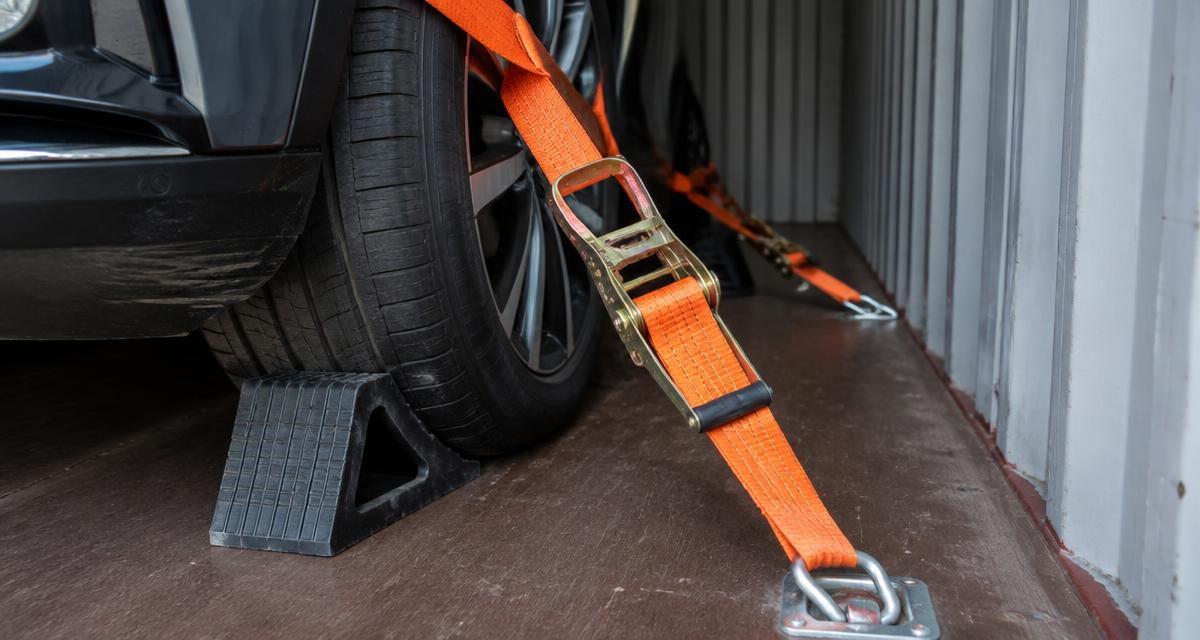
A car is secured in a shipping container by driving or winching it in, applying the handbrake and leaving it in gear or park, placing wheel chocks at each tyre, and strapping each wheel to the container's floor lashing points with rated ratchet straps or wheel nets. Timber bracing may also be nailed to the floor around the tyres. The goal is simple: the car must not move forward, backward or sideways, even in heavy seas.
Why Proper Securing Matters
Containers are lifted by cranes, stacked on ships, and moved on trucks and trains. At sea, a ship can roll and pitch for days. An unsecured car can slide into the container walls or another vehicle, causing dents, broken lights and bent suspension. Insurers expect proper lashing, and a poorly secured load can affect a claim. That is why we always recommend professional loading at a depot.
Equipment Professionals Use
Ratchet straps or wheel nets rated well above the car's weight.
Wheel chocks made of rubber, steel or timber.
Timber bracing (heat-treated to ISPM 15 standards where required) nailed to the wooden container floor.
The container's own lashing rings, which are built into the floor and side rails.
For multiple cars, racking systems that lift one car above another, or angled loading frames.
Protective covers and corner protectors for delicate cars.
Step-by-Step Loading
1. Inspect the container: clean, dry, watertight and with working doors and lashing points.
2. Prepare the car: fuel no more than a quarter full, remove loose items, fold mirrors, and check for leaks.
3. Load the car: drive in slowly with a guide, or winch it in if it is a non-runner. Most cars go in nose first.
4. Position the car centrally, leaving space to open a door if needed.
5. Apply the handbrake and put the car in gear or park.
6. Place chocks in front of and behind each tyre.
7. Strap each wheel diagonally to floor lashing points, tightening evenly. Straps should go over the tyre or through the wheel, never around suspension arms or bodywork.
8. Add timber bracing around the tyres if required.
9. Disconnect the battery if required by the carrier.
10. Photograph everything, close and seal the container, and record the seal number.
Common Mistakes to Avoid
Strapping to the suspension or exhaust can damage parts and let the car move. Over-tightening can compress the suspension so much that straps loosen as it settles. Leaving loose items in the cabin creates projectiles. Forgetting to photograph the car makes it harder to prove its condition. And overfilling the fuel tank can breach dangerous goods rules.
Securing Classic and High-Value Cars
Classic cars often have delicate chrome and older suspension. Loaders use soft straps, wheel nets, extra padding and sometimes a breathable car cover. Moisture absorbers help prevent condensation during long voyages, particularly through hot and humid regions. A sole container is recommended for the highest protection.
Multiple Cars in One Container
In a 40ft container, three or four cars can often be loaded using racking or careful positioning. Each car is secured individually, and loaders leave safe gaps between them. This is how shared container services keep costs down while still protecting each vehicle.
Unloading at the Destination
At the destination depot, the seal is checked against the documents before the doors are opened. The team photographs the car in place, removes the bracing and straps in reverse order, and drives or winches the car out slowly with a guide. Any damage is noted on the unloading report before the car leaves the depot, which is why the loading photos matter. If you use a local clearing agent, ask them to attend or request the unloading photos so you have a complete record from the UK to the final handover.
Protecting Against Condensation
Condensation, sometimes called container rain, forms when warm, humid air inside the container cools at night or as the ship moves between climates. Water droplets can fall onto the car and cause spots or, over a long voyage, corrosion. Loaders reduce this by placing desiccant bags or hanging moisture absorbers in the container, making sure the car is dry when loaded, and avoiding plastic covers that trap moisture against the paint. Breathable fabric covers are a better choice for classic cars. This is especially important for voyages through tropical regions to Asia, Australia and Africa.
Strap Ratings and Lashing Points Explained
Ratchet straps are marked with a lashing capacity (LC), usually in daN (roughly equal to kilograms). Professionals use straps and wheel nets with a lashing capacity comfortably above the load they restrain, and use at least four — one per wheel. Container floor lashing rings are rated too, typically around 1,000kg each for standard containers, so the load is spread across several points rather than relying on one. Straps are angled at roughly 30 to 45 degrees for the best restraint in both directions.
Checks Before the Container Is Sealed
Walk around the car and push firmly on each corner — it should not move. Check every strap is tight, twisted flat and not rubbing on sharp edges. Make sure nothing is resting against the container walls. Confirm the fuel level, that the handbrake is on and that the car is in gear or park. Photograph each wheel, the interior and the full container before closing the doors. Record the seal number on the loading report and send a copy to the customer. The same checks are repeated in reverse at unloading, so any damage can be traced.
If the car is shipped with personal items, they are packed in boxes, secured separately and listed on the packing list.
Why Use a Professional Loader
Loading a car yourself is possible, but most shipping lines and insurers prefer professional loading. We load cars at secure depots with the right equipment, photograph each step and provide a loading report. You can see how many cars fit in each container type in our guide on the subject, and compare options in our RoRo vs container guide.
Let Us Handle the Loading
The Ship Cars works with Ascope Shipping Services LTD, our official vehicle shipping agent in Hull, rated 4.7/5 from 710 Trustpilot reviews. You get one point of contact for UK collection, export paperwork, RoRo or container freight and advice for arrival. Every quote is fixed and based on our published country rates where they apply, so there are no surprises on the port-to-port price. Our depot teams load cars daily for customers shipping to Africa, the Middle East, Asia, Australia and the Americas.
Frequently Asked Questions
How do you secure a car in a shipping container?
Should the battery be disconnected?
Can I load my own container?
Ready to Ship Your Vehicle?
Get a free, no-obligation quote for international vehicle shipping from the UK. Check our destinations or use the cost calculator.
Written by
Zahir
SEO & Logistics Expert
Zahir is a seasoned SEO strategist and content writer specializing in international logistics, vehicle shipping, and automotive culture. With over a decade of experience in the shipping industry, he provides expert insights to help customers navigate the complexities of international vehicle transport.